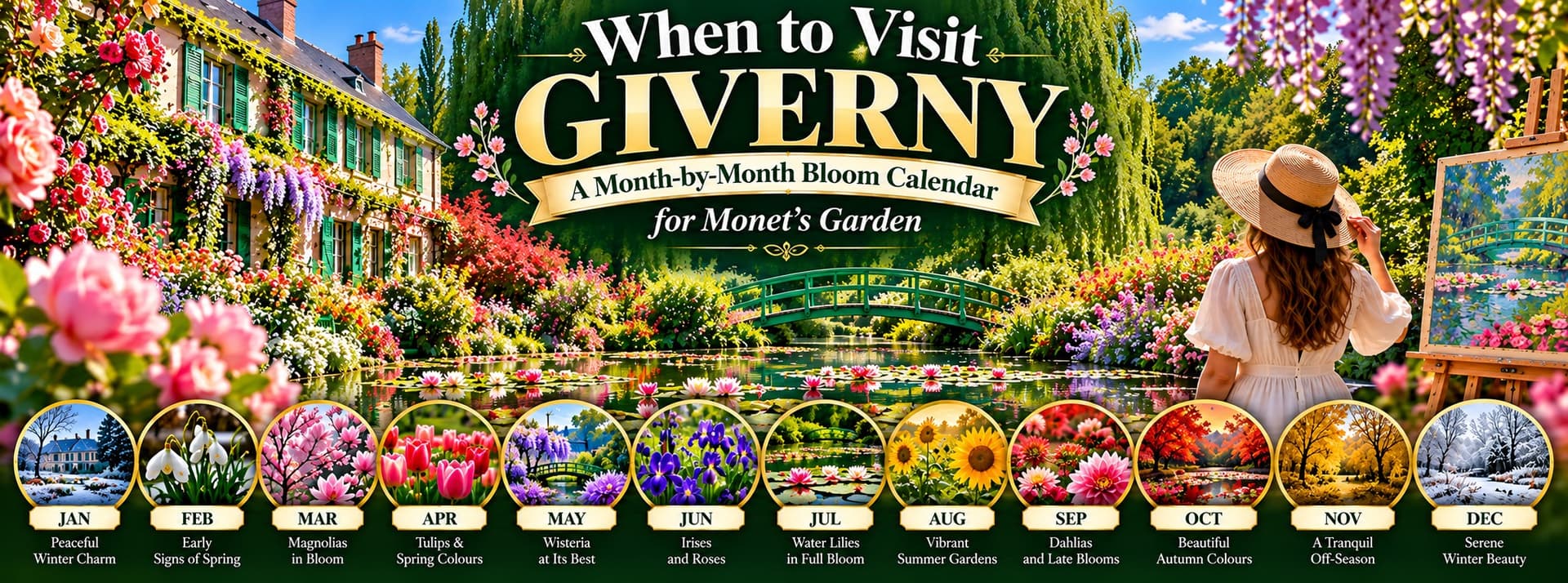
Claude Monet spent 43 years creating his garden at Giverny, and he designed it to change constantly through the seasons. That's why the question "when should I visit Giverny?" has no single answer. The house and gardens open for one season each year, from 1 April to 1 November (in 2026, daily from 10:00 to 18:00, last entry 17:30), and in those seven months the garden transforms completely. Spring bulbs give way to wisteria and irises, then roses, then the famous water lilies, and finally a blaze of dahlias in autumn. This month-by-month bloom calendar for Monet's garden will help you choose the best time for your visit.
How the garden is laid out
Monet's garden has two parts. In front of the pink house is the Clos Normand, a flower garden of densely planted beds, arches and the central Grande Allée. Across the road, reached by an underpass, is the water garden, with the pond, the water lilies, weeping willows, bamboo and the famous green Japanese bridge. Both change through the year, so each month offers something different.
April: tulips and spring bulbs
The season opens with an explosion of colour in the Clos Normand: thousands of tulips, daffodils, narcissi, hyacinths and forget-me-nots, under flowering fruit trees. It's fresh, bright and usually less crowded than later months. The water garden is still waking up, with new green leaves and early blossom.
Best for: colour, photography and fewer visitors.
May: wisteria, irises and peonies
For many gardeners, May is Giverny's peak. The wisteria drapes the Japanese bridge in purple and white, a scene Monet painted many times. Bearded irises line the paths of the Clos Normand, peonies open in the flower beds and rhododendrons and azaleas bloom by the pond. It's also one of the busiest months, so book tickets and arrive early.
Best for: the classic wisteria-on-the-bridge view.
June: roses and the first water lilies
Roses take over in June, climbing the metal arches over the Grande Allée and covering the façade of the house. Poppies and other perennials fill the beds. On the pond, the first water lilies begin to open. Long days make June a beautiful month for a relaxed visit.
Best for: rose lovers and long summer light.
July and August: the water lilies
High summer is the season of the water lilies — the flowers that became the subject of Monet's most famous series, painted for about 30 years. The water garden is lush and at its fullest, with lilies across the pond and agapanthus nearby. The Clos Normand is full of sunflowers, cosmos and summer annuals. These are also the busiest months with tour groups, so go at opening time or late in the afternoon.
Best for: the water lilies in full bloom.
September and October: dahlias and autumn colour
As summer ends, the garden turns warm and golden. Dahlias of every shape and colour fill the beds, along with asters and sunflowers. Along the Grande Allée, nasturtiums spread across the path until it almost disappears. In the water garden, autumn foliage reflects in the pond. The light is softer, the crowds thinner — October is one of the most underrated months to visit.
Best for: rich colour, softer light and calmer paths.
November to March: closed
The house and gardens close for winter. The village of Giverny is quiet, and the Musée des Impressionnismes follows its own exhibition calendar. If you're in Paris in winter, plan a spring return — or visit the Musée de l'Orangerie in Paris to see Monet's great water lily panels.
Tips for any month
- Book timed tickets in advance, especially in May and summer.
- Arrive at opening or after 16:00 to avoid tour coaches.
- Allow at least two hours for the house and both gardens.
- Wear comfortable shoes: paths are gravel and can be narrow.
- Visit the village too: the Musée des Impressionnismes, the church where Monet is buried, and cafés along the main street.
Getting to Giverny from Paris
Giverny is about 75 km from central Paris, roughly 1h15 by car. By train, you travel from Paris Saint-Lazare to Vernon, then take a shuttle bus or taxi for the last 5 km. A private driver collects you at your hotel and lets you choose your arrival time — ideal for beating the crowds at opening, or arriving late for golden-hour light. Check the Luxberri deals page for current Giverny offers.
Photography tips for Monet's garden
Giverny is one of the most photographed gardens in the world, and a little planning helps you take home better pictures. The soft light of early morning and late afternoon flatters the flowers and reflections far more than the harsh midday sun. Cloudy days are excellent for flower close-ups, with even light and rich colours. On the water lily pond, look for reflections of the willows and sky between the lilies — the effect Monet chased for decades. The Japanese bridge is busiest in the middle of the day; arrive at opening for a clearer view. Tripods may be restricted on busy days and narrow paths, so check the rules before your visit. Photography inside Monet's house may be restricted, so ask at the entrance.
Where to eat in Giverny
The village has a handful of restaurants and cafés within walking distance of the gardens, from simple crêperies to a historic hotel-restaurant once frequented by American painters who came to work near Monet. In high season, book lunch ahead or plan to eat early. With a private driver, you can also stop for lunch in nearby Vernon or continue to a restaurant in the Seine valley on the way back to Paris.
Combining Giverny with other visits
Giverny pairs naturally with Rouen, about an hour further on, where Monet painted the cathedral, or with Auvers-sur-Oise, where Van Gogh spent his final months. Both combinations make a full day by car.
More questions
Can I visit Giverny in winter?
The gardens are closed from November to late March.
How long do I need at Giverny?
About two to three hours, including the village.