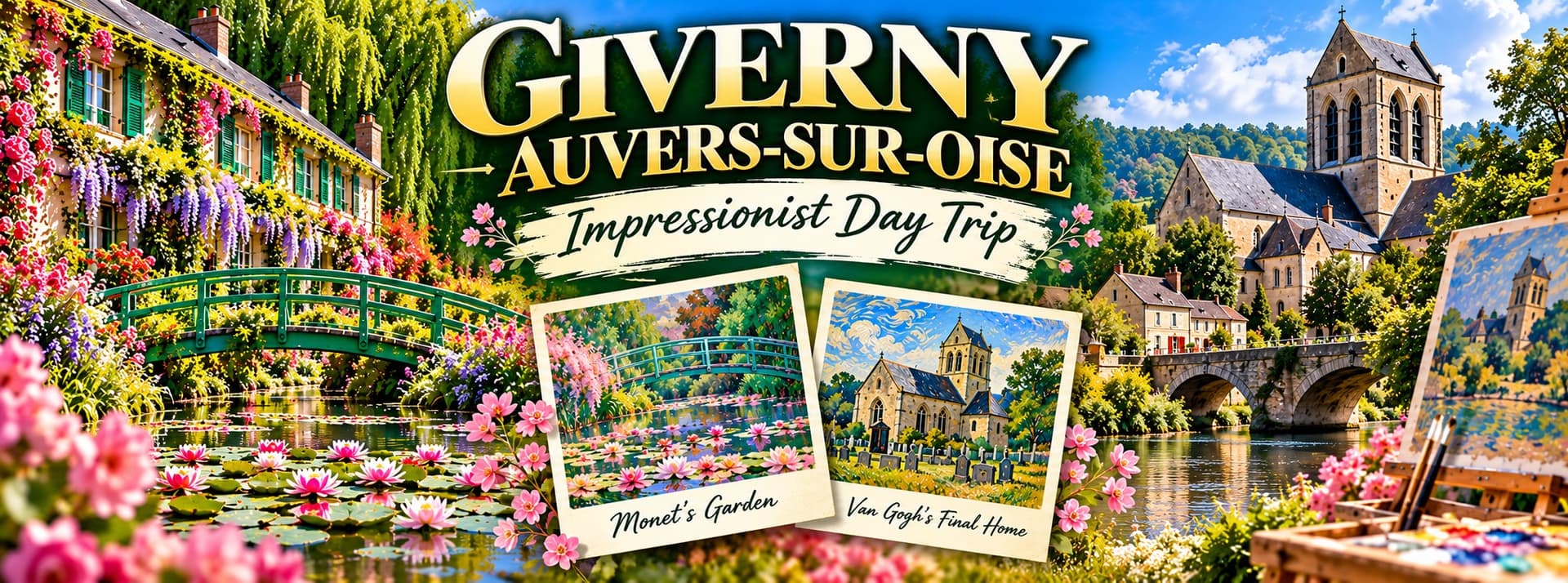
Two of the most important places in the history of Impressionism lie northwest of Paris, about an hour apart. In Giverny, Claude Monet lived for 43 years and created the garden and water lily pond he painted obsessively. In Auvers-sur-Oise, Vincent van Gogh spent the last 70 days of his life in 1890, painting around 70 works — almost one a day — before his death. Visiting both in one day gives you two sides of the same artistic revolution: Monet's luminous, lifelong garden and Van Gogh's intense final summer. This guide plans the Impressionist day trip from Paris, with route, timing and highlights.
Why combine Giverny and Auvers?
The two villages tell connected stories. Monet was a founder of Impressionism, and Giverny shows where its ideas about light and colour led over decades. Van Gogh, who arrived in Paris in 1886, absorbed Impressionism and pushed it further. Auvers was also a favourite of earlier painters such as Daubigny, Pissarro and Cézanne. Seeing the real places — the garden, the church, the wheat fields — next to the paintings you know makes both artists come alive.
The challenge is getting between them. There's no direct train link, and coach tours rarely include both. By car, it's a smooth loop.
Morning: Giverny
Start early and arrive at Giverny, about 1h15 from central Paris, for opening time. Visit:
- Monet's house: the pink house with green shutters, his studio-salon, the yellow dining room and the blue kitchen, with his collection of Japanese prints.
- The Clos Normand: the flower garden in front of the house, with seasonal displays from tulips to dahlias.
- The water garden: the pond, the water lilies, the weeping willows and the green Japanese bridge.
Allow about two hours. The gardens are open daily from 1 April to 1 November. If time allows, the Musée des Impressionnismes Giverny, a short walk away, hosts temporary exhibitions.
Midday: drive through the Vexin
From Giverny, the drive to Auvers-sur-Oise takes about an hour through the French Vexin, a regional nature park of farmland, small villages and stone churches. Stop for lunch in a village restaurant or continue to Auvers for lunch.
Afternoon: Auvers-sur-Oise
Auvers is a small, peaceful village on the Oise river, and many of Van Gogh's subjects are still recognisable. Information panels mark the spots where he set up his easel, showing reproductions of the paintings. Highlights:
- Auberge Ravoux (Maison de Van Gogh): the inn where Van Gogh rented a tiny attic room for a few francs a day. You can visit the room, kept bare and simple, and eat in the restaurant downstairs; it's seasonal, so check opening dates.
- The church of Notre-Dame d'Auvers: the subject of one of his most famous paintings, now in the Musée d'Orsay.
- The wheat fields: on the plateau above the village, the landscape of Wheatfield with Crows still stretches to the horizon.
- The cemetery: Vincent and his brother Theo are buried side by side, their graves covered in ivy.
- Dr Gachet's house: home of the doctor and art lover who cared for Van Gogh; check opening days.
- Château d'Auvers: a 17th-century château with an immersive multimedia journey through the Impressionist era.
- Musée Daubigny and the Atelier de Daubigny: for the landscape painter who drew others to Auvers.
Auvers is only about 35 km from Paris, so the drive home is short.
Suggested timing
- 8:15 — Pickup at your Paris hotel.
- 9:30 — Giverny: house and gardens.
- 11:45 — Drive through the Vexin.
- 13:00 — Lunch in Auvers-sur-Oise.
- 14:30 — Auberge Ravoux, the church and the wheat fields.
- 16:00 — Cemetery and Château d'Auvers.
- 17:30 — Return to Paris, arriving around 18:30.
Outside Giverny's season
When Giverny is closed (November to March), Auvers-sur-Oise still works well. Combine it with Château de Chantilly and its art collections, or with the medieval town of Senlis, for a full day outside Paris.
Why do this trip with a private driver
- No train connections to plan between Giverny, Auvers and Paris.
- Arrive at opening in Giverny before the coaches.
- Your own pace — linger in the wheat fields or skip a stop.
- Room for everyone: up to seven passengers in a Mercedes V-Class.
- Option to add a guide: an art-history guide can join for the day.
See current offers on the Luxberri deals page.
See the paintings in Paris before or after your trip
The best way to prepare for this day is to see the paintings themselves. Paris has three essential museums for Monet and Van Gogh:
- Musée d'Orsay: the world's greatest collection of Impressionist and Post-Impressionist art, including Van Gogh's The Church at Auvers, his self-portraits from Auvers and Portrait of Dr Gachet, and Monet's Rouen Cathedral series paintings.
- Musée de l'Orangerie: Monet's monumental Water Lilies panels, displayed in two oval rooms he helped design, painted from the pond you'll see at Giverny.
- Musée Marmottan Monet: the largest collection of Monet's works, including Impression, Sunrise, the painting that gave Impressionism its name.
Visiting the Orangerie or Orsay the day before Giverny and Auvers makes the trip more meaningful: you'll recognise the bridge, the pond, the church and the fields from the canvases. Book museum tickets in advance, especially at weekends.
A short history of Impressionism outside Paris
The Impressionists were drawn out of Paris by the railway, which made the countryside and the coast easy to reach. They painted outdoors, en plein air, trying to capture changing light and atmosphere. The valleys of the Seine and the Oise became their open-air studio: Argenteuil, Pontoise, Auvers, Vétheuil and finally Giverny. Driving between Giverny and Auvers, you cross the same landscapes that inspired Pissarro, Cézanne, Daubigny, Monet and Van Gogh, which is why this route is often called the Impressionist trail.
Best season for this trip
The Impressionist day works best between April and October, when Giverny's gardens are open and the fields around Auvers are green or golden. Late June to August brings the water lilies at Giverny and the ripening wheat that Van Gogh painted in his final summer. September and October are quieter, with softer light and autumn colour along the Oise and the Seine.
More questions
Is this trip possible in winter?
Auvers is open year-round; Giverny's gardens close in winter.
Can we add an art guide?
Yes, a guide can join on request.