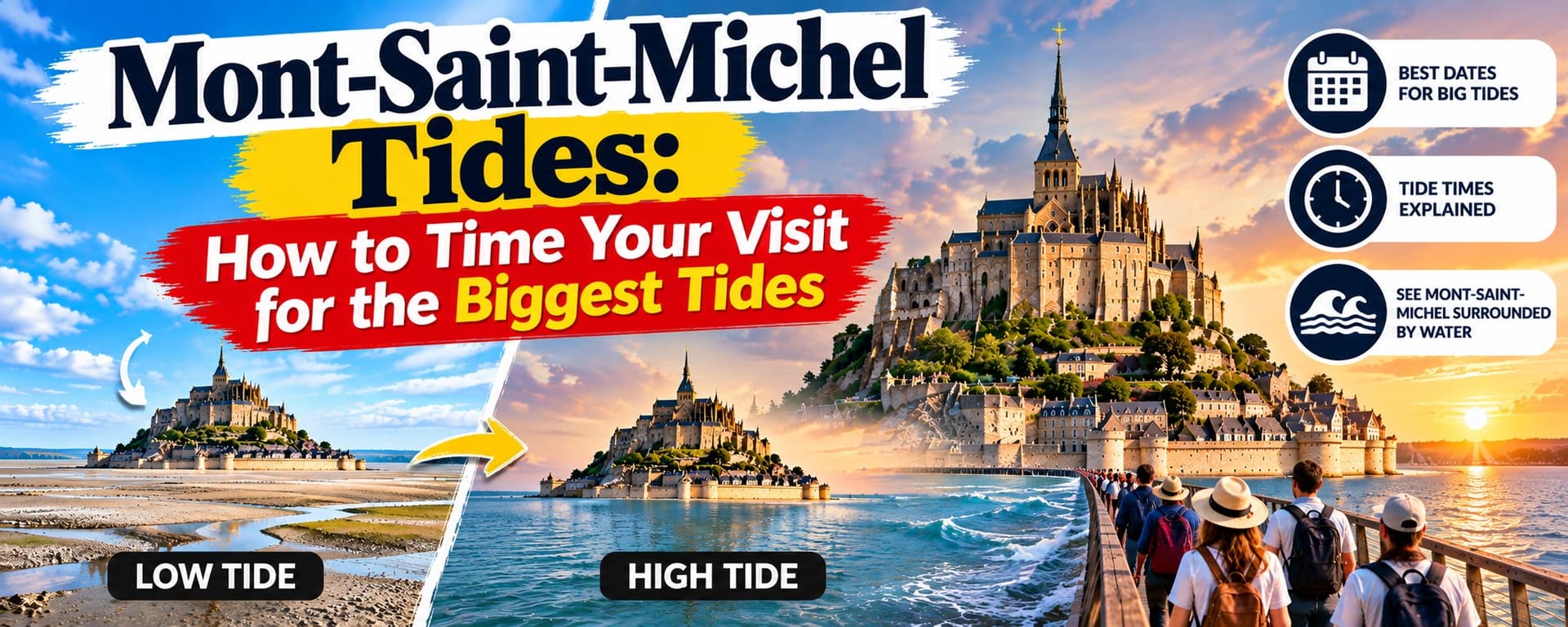
Mont-Saint-Michel is spectacular at any time, but the sea around it is what makes it unique. The bay has some of the strongest tides in continental Europe, with a difference of up to about 14 to 15 metres between low and high water on the biggest days. At low tide, the Mont rises above a vast expanse of sand and silver channels. At the highest tides, the sea rushes in across the flats and, for a short while, surrounds the Mont completely, turning it back into an island. Timing your visit around the tides can make the difference between a nice day and an unforgettable one. This guide explains how Mont-Saint-Michel tides work and how to time your visit for the biggest tides — including how to plan the four-hour drive from Paris.
Why are the tides so big here?
The bay of Mont-Saint-Michel is wide, shallow and funnel-shaped, opening onto the Gulf of Saint-Malo in the English Channel. As the tide comes in, the water is squeezed into the bay, amplifying the rise. The flats are so flat that the sea covers large distances very quickly at the turn of a big tide. It's often said the sea comes in "as fast as a galloping horse" — an exaggeration, but on big tides it's faster than you can comfortably walk.
Understanding tide coefficients
French tide tables give each tide a coefficient between 20 and 120, measuring its strength:
- Below 70: small tides; the sea doesn't reach the Mont.
- 70 to 90: medium tides; the water comes closer but rarely surrounds the Mont.
- Above about 90 to 100: big tides (grandes marées); the sea fills the bay dramatically.
- Above about 110: exceptional tides, when the Mont can briefly become an island the end of the causeway can be covered for a short time, and the shuttle is paused.
The biggest tides usually occur a day or two after a full or new moon, and the most powerful ones of the year come around the spring and autumn equinoxes, in March and September–October.
Where to watch the tide come in
- From the ramparts and the abbey terraces: the best panoramic views of the water spreading across the bay.
- From the bridge-causeway: watch the water arrive around the Mont's base. On the very highest tides, the end of the bridge can be covered, so follow official instructions.
- From the Couesnon dam (Barrage du Couesnon): on the mainland, this offers the classic view of the Mont surrounded by water, and you can watch the dam's gates release water at certain times.
Arrive at least an hour before high tide to find a good spot.
Safety: never walk the bay alone
The flats look harmless at low tide, but they're dangerous. The tide rises quickly, fog can roll in, and there are areas of quicksand. Never walk on the sand without a certified bay guide. Guided bay walks (traversées de la baie) are a wonderful experience, walking barefoot across the sand to the island of Tombelaine or around the Mont, with a guide who knows the timing and the terrain; book with an approved guide.
Planning your visit from Paris
Mont-Saint-Michel is about 360 km and roughly 4 hours by road from Paris. If you want to see a big high tide:
- Check the official tide calendar on the Mont-Saint-Michel tourism website for the dates and times of high tides and their coefficients.
- Work backwards from high tide. For an afternoon high tide, a day trip can work: leave Paris early in the morning and arrive with time to visit the abbey first.
- For a morning high tide, stay overnight near the Mont so you're there in time.
- Stay for dusk if you can. The Mont is lit after dark, and the day crowds leave.
A coach tour runs on a fixed schedule; it can't move departure time to match the tide. A private driver can. With Luxberri, you set the departure time around the tide calendar, and for groups up to seven, a Mercedes V-Class keeps everyone together. Check the Luxberri deals page for current offers.
Other timing tips
- Avoid the busiest hours: arrive before 10:00 or after 16:00 if you can.
- Visit the abbey early, before climbing crowds peak.
- Low tide is beautiful too: reflections in the wet sand and guided bay walks happen at low tide.
- Dress for the weather: wind and rain can arrive quickly on the coast.
How to read a tide table for your visit
The official tide calendar lists, for each day, the times of high and low tide and the coefficient for each tide. Two high tides occur each day, roughly 12 hours and 25 minutes apart, so the time shifts later by about 50 minutes each day. When planning:
- Look for days with a coefficient above about 90 if you want to see the sea surround the Mont.
- Note the time of high tide. The most dramatic part is the hour before, when the water rushes in across the flats.
- Remember that high tide at the Mont may differ slightly from the time printed for nearby ports, so use the Mont's own calendar.
- Check the weather. Strong westerly winds can push the water higher than predicted.
If no big tides fall during your trip, don't worry. The bay is beautiful at every coefficient, and low tide offers its own magic: shining sand, reflections and the chance to join a guided walk.
The Mont through the seasons
Each season changes the experience. Spring brings equinox tides, lambs on the salt meadows and fewer visitors before Easter. Summer has long days and evening events, but also the biggest crowds; arrive early or stay late. Autumn brings the strongest tides of the year around the September equinox, softer light and calmer streets in October and November. Winter is quiet and atmospheric, with misty mornings, though some shops and restaurants close and days are short. The abbey is open year-round except on a few public holidays (1 January, 1 May and 25 December).
Combining the tides with Saint-Malo
Saint-Malo, under an hour away, has similar big tides and its own tidal island walk to Grand Bé. On a two-day trip, you can watch high tide at the Mont one evening and explore Saint-Malo at low tide the next morning.
More questions
Is a guided bay walk worth it?
Yes, with a certified guide only.
Can I see a big tide on a day trip from Paris?
Yes, if high tide is in the afternoon; otherwise stay overnight.