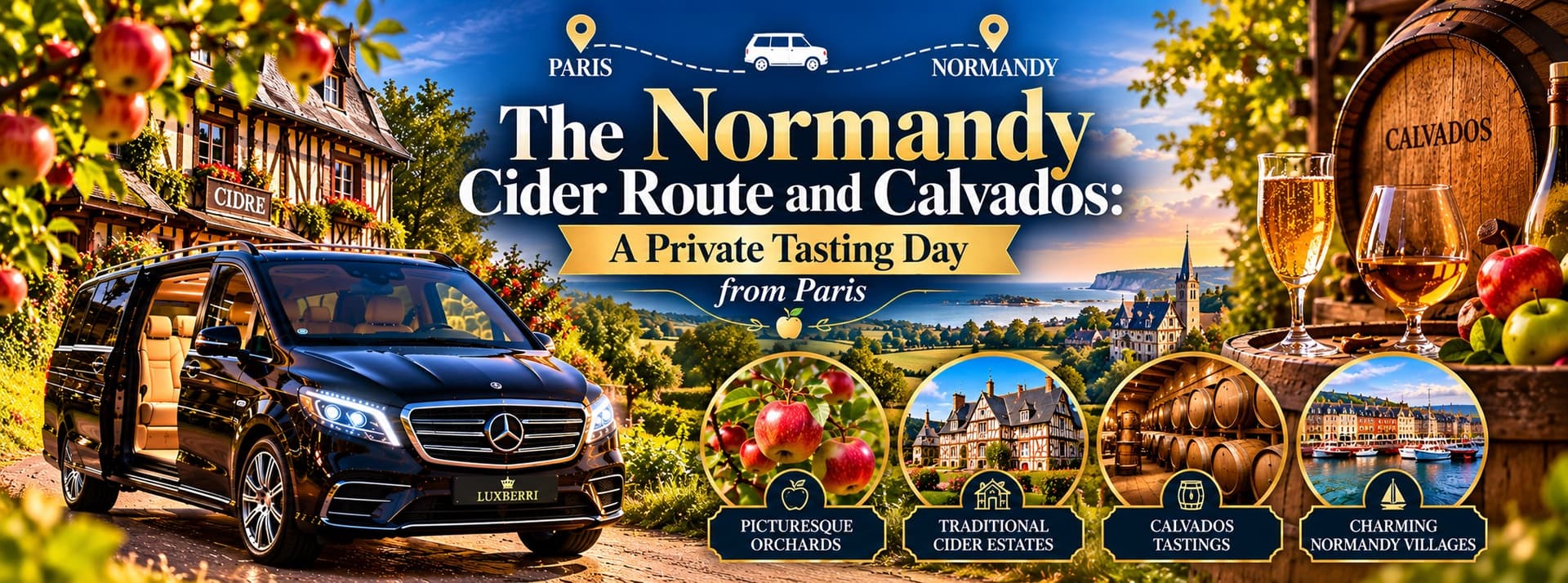
Normandy doesn't make wine — it's too far north and too wet for vineyards. Instead, it has apples. For centuries, the orchards of the Pays d'Auge have produced some of the finest cider in France, along with pommeau and Calvados, the famous apple brandy. The Route du Cidre, a signposted loop of about 40 km through rolling hills, half-timbered farms and pretty villages, connects many of the region's producers. It's one of the most charming and least crowded experiences in Normandy. This guide plans a private tasting day on the Normandy Cider Route from Paris, with what to taste, where to stop and why it's a trip made for a chauffeur.
What you'll taste
- Cidre (cider): Normandy cider is naturally sparkling and ranges from brut (dry) to demi-sec and doux (sweet). The best farm ciders are made from blends of bitter, sweet and acidic apple varieties, and many carry the AOP Cidre Pays d'Auge label.
- Poiré: a delicate sparkling drink made from pears, a speciality of the Domfrontais area further south.
- Pommeau: a blend of apple juice and young Calvados, aged in oak and served chilled as an aperitif.
- Calvados: apple brandy distilled from cider and aged in oak barrels. Young Calvados (Fine or VS) is fresh and fruity; older ones (XO, Hors d'Âge, or vintage) develop notes of dried fruit, vanilla and spice. Calvados Pays d'Auge is double-distilled in traditional copper pot stills.
And the cheese
The Pays d'Auge is also cheese country. Three of France's most famous cheeses take their names from nearby villages: Camembert, Livarot and Pont-l'Évêque. Many producers sell cheese alongside cider, and a farm lunch with cider, cheese and apple tart is a highlight of the day.
Villages and stops on the Cider Route
- Beuvron-en-Auge: listed among the Most Beautiful Villages of France, with a central square of colourful timber-framed houses, cafés and antique shops.
- Cambremer: at the heart of the Cidre Pays d'Auge appellation, and a good base for visiting producers.
- Bonnebosq, Beaufour-Druval and Victot-Pontfol: small villages with farm producers, manor houses and orchard views.
- Crèvecœur-en-Auge: a restored medieval castle complex with farm buildings and exhibitions; check opening days.
Family-run producers marked with the "Cru de Cambremer" sign welcome visitors to taste and buy. Opening hours vary, so it's wise to call ahead or let your driver plan the stops.
Larger Calvados houses
For a more structured visit, several established Calvados distilleries in the Pays d'Auge offer guided tours of their orchards, cellars and distilling equipment, with tastings of different ages; book ahead. Combining one larger house with one or two small farms gives a good picture of the region.
Getting there from Paris
The Pays d'Auge is about 200 km from Paris, roughly 2 hours 15 minutes by car via the A13. There's no practical public transport between the villages and producers. As a day trip, it's a long but rewarding day. Many travellers combine it with Honfleur or Deauville, or make it part of a Normandy weekend or week-long tour.
A sample day
- 8:30 — Pickup in Paris.
- 10:45 — First stop: a Calvados house tour and tasting.
- 12:30 — Lunch in Beuvron-en-Auge: local cheese, cider and apple tart.
- 14:00 — Walk around the village square.
- 14:45 — Farm visit and tasting with a family cider producer near Cambremer.
- 16:00 — Optional stop in Honfleur, 40 minutes away, for the harbour.
- 17:30 — Return to Paris, arriving around 20:00.
Why this trip needs a private driver
It's a tasting day by definition, and Calvados is around 40% alcohol. With a private driver, everyone in the group can taste freely. The roads between producers are narrow country lanes, often poorly signposted, and the driver handles the navigation. Bottles bought along the way stay safely in the car. For groups of up to seven, a Mercedes V-Class keeps everyone together; couples travel comfortably in an E-Class or S-Class. See current offers on the Luxberri deals page.
When to go
- April to May: orchards in blossom, the prettiest time for photos.
- September to October: the apple harvest, with fruit on the trees and cider-making underway.
- Late October: in some years, cider and apple festivals take place in the villages; check local listings.
- Winter: quieter; check opening hours with producers.
How cider and Calvados are made
Understanding the process makes each tasting more interesting. In autumn, apples fall or are shaken from tall orchard trees, then left to mature before being crushed. The juice ferments slowly, often over several months in the cold farm cellars, and natural fermentation continues in the bottle to create the gentle sparkle of farm cider. Many producers still use traditional, high-stemmed orchards where cows graze beneath the trees, a landscape typical of the Pays d'Auge.
To make Calvados, cider is distilled into a clear spirit, then aged in oak barrels for at least two years. The longer it ages, the more colour and complexity it gains. Labels indicate the minimum age:
- Fine or VS: at least two years in oak.
- Vieux or Réserve: at least three years.
- VO or Vieille Réserve: at least four years.
- XO, Hors d'Âge or Très Vieille Réserve: at least six years.
Many producers also sell vintage Calvados from a single year. At the end of a long Normandy meal, locals sometimes drink a small glass of Calvados between courses — the famous trou normand — said to make room for the next dish.
Cooking with apples and cider
Look for dishes cooked with cider or Calvados: chicken or pork vallée d'Auge, with cream, apples and Calvados; mussels in cider; and apple tarts and caramelised apples for dessert. Many farm producers sell apple jelly, cider vinegar and caramel to take home.
Making it a weekend
If a single day feels rushed, stay a night in the Pays d'Auge. Several manor houses and farm guesthouses sit among the orchards, and a night there lets you add Honfleur's harbour, the Deauville boardwalk or the cliffs of Étretat the next morning. Your chauffeur can drop you on the first day and collect you on the second, which often costs less than keeping a car for two full days.
More questions
How long is the drive from Paris?
About 2 hours 15 minutes.
Can we combine the Cider Route with Honfleur?
Yes, Honfleur is about 40 minutes away.