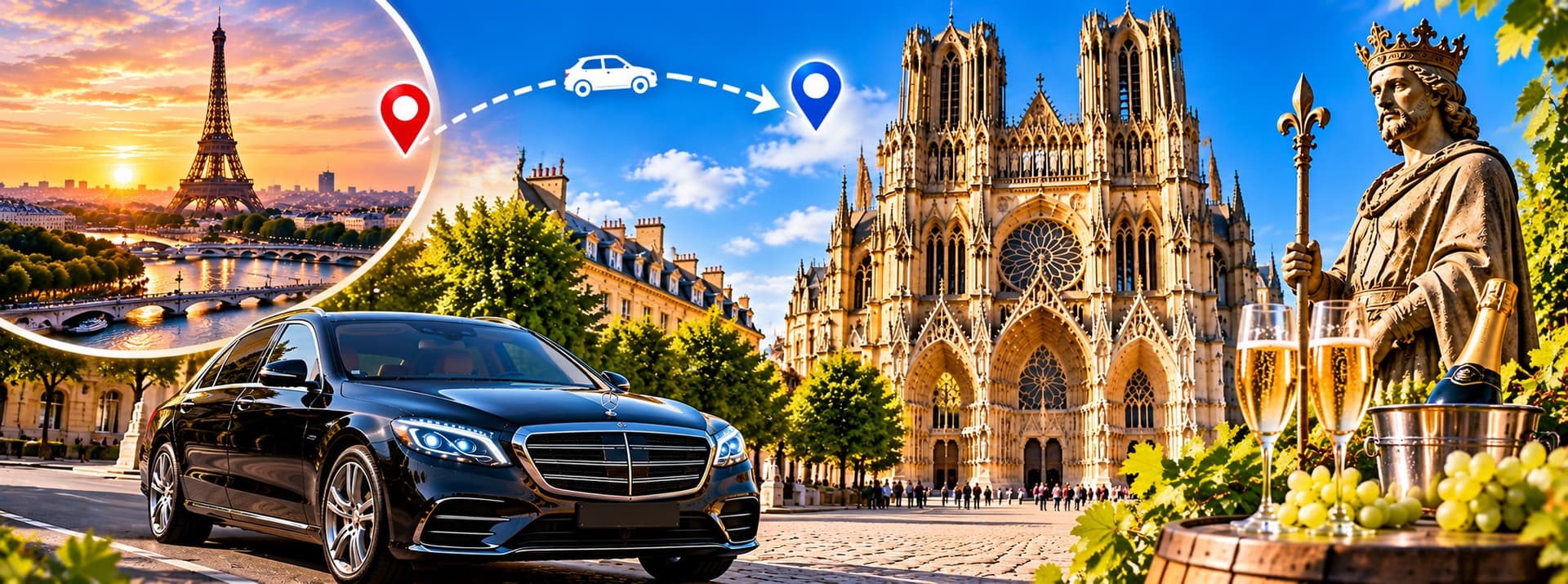
Most visitors come to Reims for Champagne, and they're right to — but they often miss the city's other story. For centuries, Reims was where the kings of France were crowned. Its Gothic cathedral, the neighbouring Palais du Tau and the Basilica of Saint-Remi are listed together as a UNESCO World Heritage site, and they tell the story of the French monarchy from its very beginning. A Reims Cathedral day trip from Paris lets you discover the city of kings beyond the cellars, with time for one Champagne tasting to round off the day.
Why Reims was the city of kings
The story begins around the year 500, when Clovis, King of the Franks, was baptised in Reims by Bishop Remi. That baptism became a symbol of the alliance between the French crown and the Church. From the Middle Ages onwards, most French kings travelled to Reims to be crowned and anointed in the cathedral. The most famous coronation took place in 1429, when Charles VII was crowned with Joan of Arc standing beside him, a turning point in the Hundred Years' War.
Notre-Dame de Reims: the coronation cathedral
The cathedral you see today was begun in the early 13th century and is one of the masterpieces of High Gothic architecture. Highlights include:
- The west façade: home to many of the cathedral's roughly 2,300 statues, it's one of the richest sculpted façades in Europe.
- The Smiling Angel (L'Ange au Sourire): a statue on the left portal, famous for its gentle smile and a symbol of Reims.
- The rose window: glowing above the main door in late-afternoon light.
- The Chagall windows: stained glass designed by Marc Chagall in the axial chapel, in deep blues and reds.
- War damage and restoration: the cathedral was heavily shelled in the First World War, and its restoration became a symbol of reconciliation.
Allow 45 minutes to an hour inside, more if you join a guided tour or book a seasonal tower visit.
Palais du Tau: the treasures of the coronations
Right next to the cathedral stands the Palais du Tau, the former residence of the Archbishop of Reims. Kings stayed here before their coronation and held a great banquet afterwards. Today it's a museum displaying the cathedral treasury — reliquaries, coronation robes and objects linked to the ceremonies — and original statues removed from the façade to protect them from weather. It's an essential visit for understanding the cathedral itself.
Basilica of Saint-Remi: the quiet masterpiece
About 20 minutes' walk south of the cathedral, the Basilica of Saint-Remi is a vast Romanesque and early Gothic church that holds the tomb of Saint Remi, the bishop who baptised Clovis. It's usually far quieter than the cathedral, with a peaceful nave and beautiful light. The adjoining Saint-Remi Museum, in the former abbey buildings, covers local history from Gallo-Roman times; check opening days before you go.
Add one Champagne cellar
No day in Reims is complete without Champagne. The Saint-Nicaise hill, close to Saint-Remi, is home to famous houses whose cellars are carved into Gallo-Roman chalk pits called crayères. These are part of a separate UNESCO listing, the Champagne hillsides, houses and cellars. A one-hour guided tour with a tasting fits perfectly into the afternoon.
Other things to see in Reims
- Place Drouet-d'Erlon: a lively pedestrian street with cafés and brasseries for lunch.
- Museum of the Surrender: where Germany signed its surrender to the Allies in May 1945, a reminder of Reims' role in the Second World War.
- Halles du Boulingrin: an Art Deco covered market, open on certain days.
A suggested itinerary
- 9:00 — Leave Paris with your private driver.
- 10:30 — Reims Cathedral, inside and out.
- 11:30 — Palais du Tau.
- 12:45 — Lunch around Place Drouet-d'Erlon.
- 14:15 — Basilica of Saint-Remi.
- 15:30 — Champagne cellar tour and tasting on the Saint-Nicaise hill.
- 17:15 — Drive back to Paris, arriving around 19:00.
Why go with a private driver
The three UNESCO monuments and the Champagne houses are spread across the city. With a driver, you skip the walk between Saint-Remi and the cathedral if you're short on time, and the car waits outside each visit. You can taste freely, store purchases in the car and choose your own pace. For a group, a Mercedes V-Class takes up to seven passengers. See current offers on the Luxberri deals page.
Reims in the 20th century: war and Art Deco
Reims suffered terribly in the First World War. The city was on the front line for four years and was bombarded so heavily that most of it was destroyed, and the cathedral itself burned in 1914. Images of the damaged cathedral were seen around the world. The reconstruction of the 1920s gave Reims a remarkable collection of Art Deco buildings, with decorated façades, ironwork and mosaics. Look for them around Place Drouet-d'Erlon, the Carnegie Library, funded by an American foundation, and the Halles du Boulingrin covered market. In 1945, Reims made history again: on 7 May, the German surrender was signed in General Eisenhower's headquarters, a school building that is now the Museum of the Surrender. Together, these sites make Reims a fascinating destination for anyone interested in 20th-century history, not only the Middle Ages.
Visiting Reims with children
Children often enjoy the cathedral more than adults expect: spotting the Smiling Angel, finding animals and monsters among the carvings, and seeing the colourful Chagall windows. Champagne cellars welcome families, and many houses offer grape juice or non-alcoholic tastings for younger visitors; ask when you book. Keep the day varied, with a picnic or a break in a park, and ask for child seats when you book your car.
Best time of year to visit Reims
Reims is rewarding in every season. Spring and early summer bring long days and pleasant walks between the monuments. September and October add the grape harvest in the surrounding vineyards, when the countryside is at its busiest and most atmospheric. Winter is quieter and colder, but the Christmas market and the floodlit cathedral make December special. Whatever the month, book cellar tours ahead, especially at weekends.
More questions
Is Reims a good day trip for history lovers?
Yes, it's one of the most important historic cities in France.
How far is Reims from Paris?
About 1h30 by car.
Can I see the Museum of the Surrender on the same day?
Yes, it's in the city centre and needs about 45 minutes.